Mosasaurs tooth
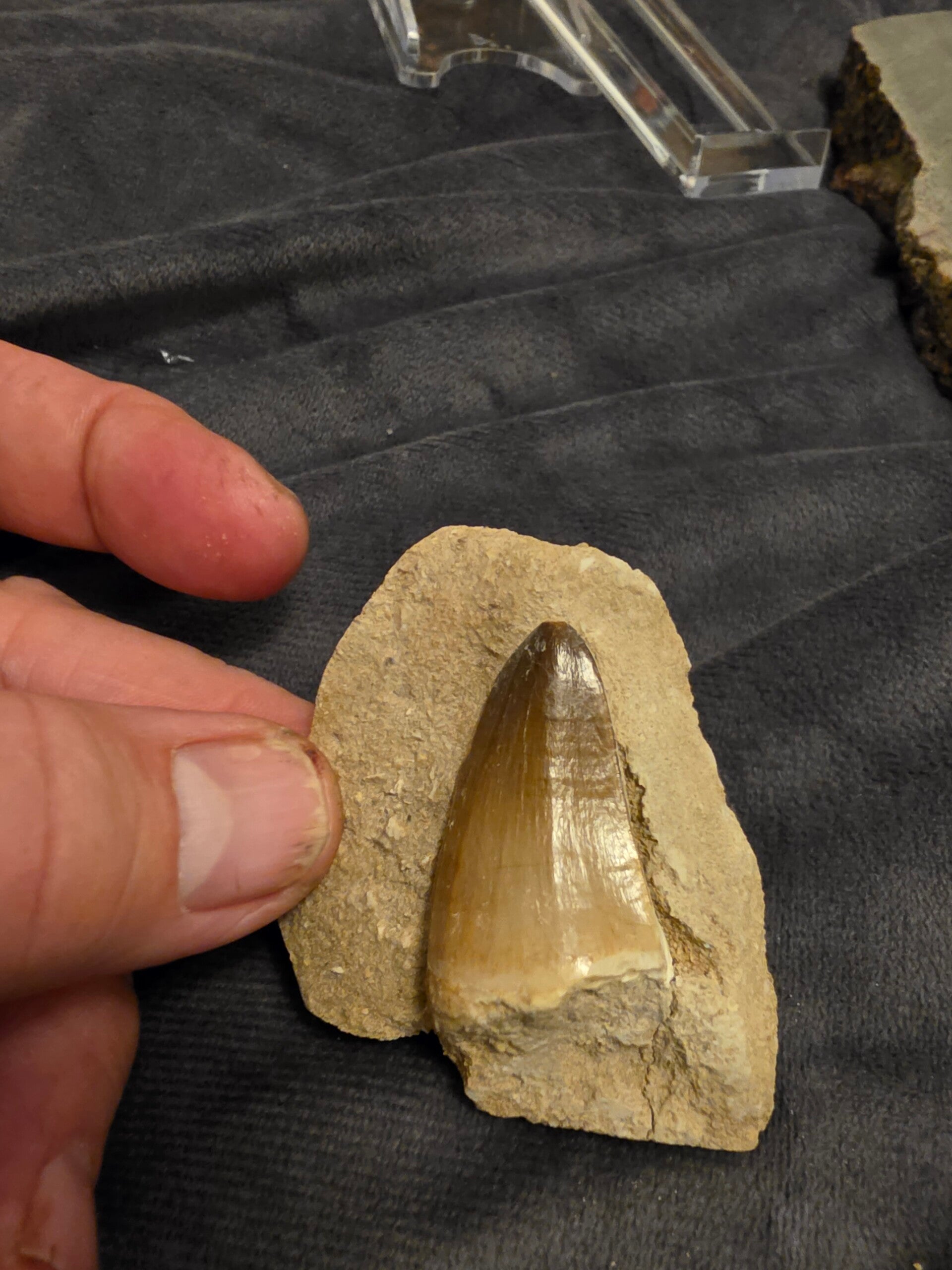
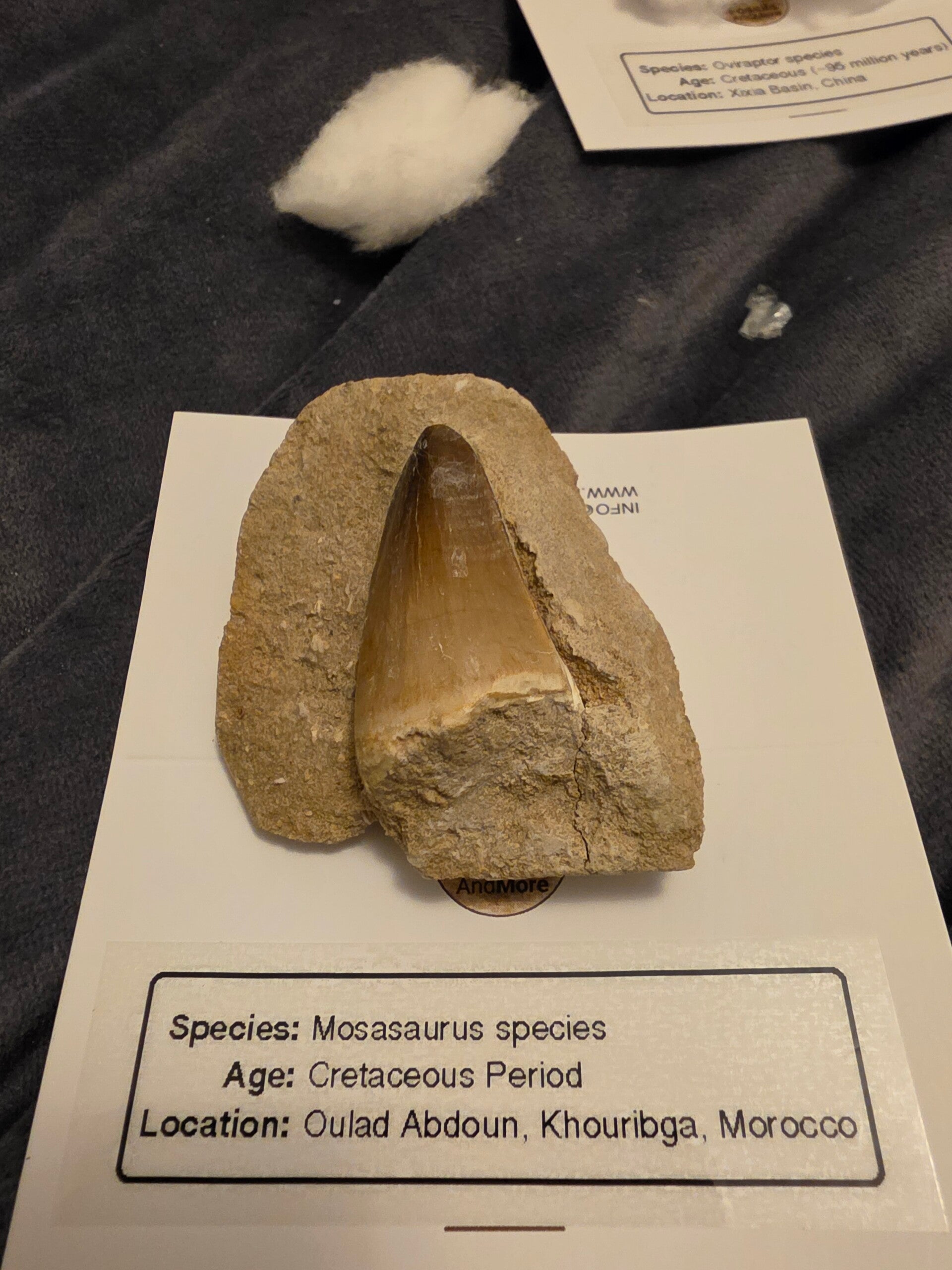
Mosasaurs are not dinosaurs because they belong to an entirely different branch of the reptile family tree. While dinosaurs were terrestrial (land-dwelling) creatures, mosasaurs were fully aquatic marine reptiles closely related to modern snakes and monitor lizards.
During the last 20 million years of the Cretaceous period (Turonian–Maastrichtian ages), with the extinction of the ichthyosaurs and pliosaurs, mosasaurids became the dominant marine predators. They themselves became extinct as a result of the K-Pg event at the end of the Cretaceous period, about 66 million years ago
Mosasaurs breathed air, were powerful swimmers, and were well-adapted to living in the warm, shallow inland seas prevalent during the Late Cretaceous period. Mosasaurs were so well adapted to this environment that they most likely gave birth to live young, rather than returning to the shore to lay eggs as sea turtles do.
The smallest-known mosasaur was Dallasaurus turneri, which was less than 1 m (3.3 ft) long. Larger mosasaurs were more typical, with many species growing longer than 4 m (13 ft). Mosasaurus hoffmannii, the largest known species reached up to 17 m (56 ft),[3] but it has been considered to be probably overestimated by Cleary et al. (2018).
Mosasaurs had a body shape similar to that of modern-day monitor lizards (varanids), but were more elongated and streamlined for swimming. Their limb bones were reduced in length and their paddles were formed by webbing between their long finger and toe bones. Their tails were broad and laterally compressed, terminating in a fluke-like structure that served as the primary source of propulsion.
Until recently, mosasaurs were assumed to have swum in a method similar to the one used today by conger eels and sea snakes, undulating their entire bodies from side to side. However, new evidence suggests that many advanced mosasaurs had large, crescent-shaped flukes on the ends of their tails, similar to those of sharks and some ichthyosaurs. Rather than use snake-like undulations, their bodies probably remained stiff to reduce drag through the water, while their tails provided strong propulsion. These animals may have lurked and pounced rapidly and powerfully on passing prey, rather than chasing after it. At least some species were also capable of aquaflight, flapping their flippers like sea lions.